Discover Beauty, Self-Care & Everyday Essentials You’ll Love💖Shop our latest arrivals HERE✨


Vanicream Daily Facial Moisturizer vs CeraVe: Which Is Better for Your Skin?

Finding a facial moisturizer that hydrates without stinging, clogging your pores, or leaving a greasy film is harder than it should be. As someone who is familiar with Vanicream and CeraVe for many years. When someone asks me for a simple, barrier-friendly moisturizer, these are the first two brands I name.
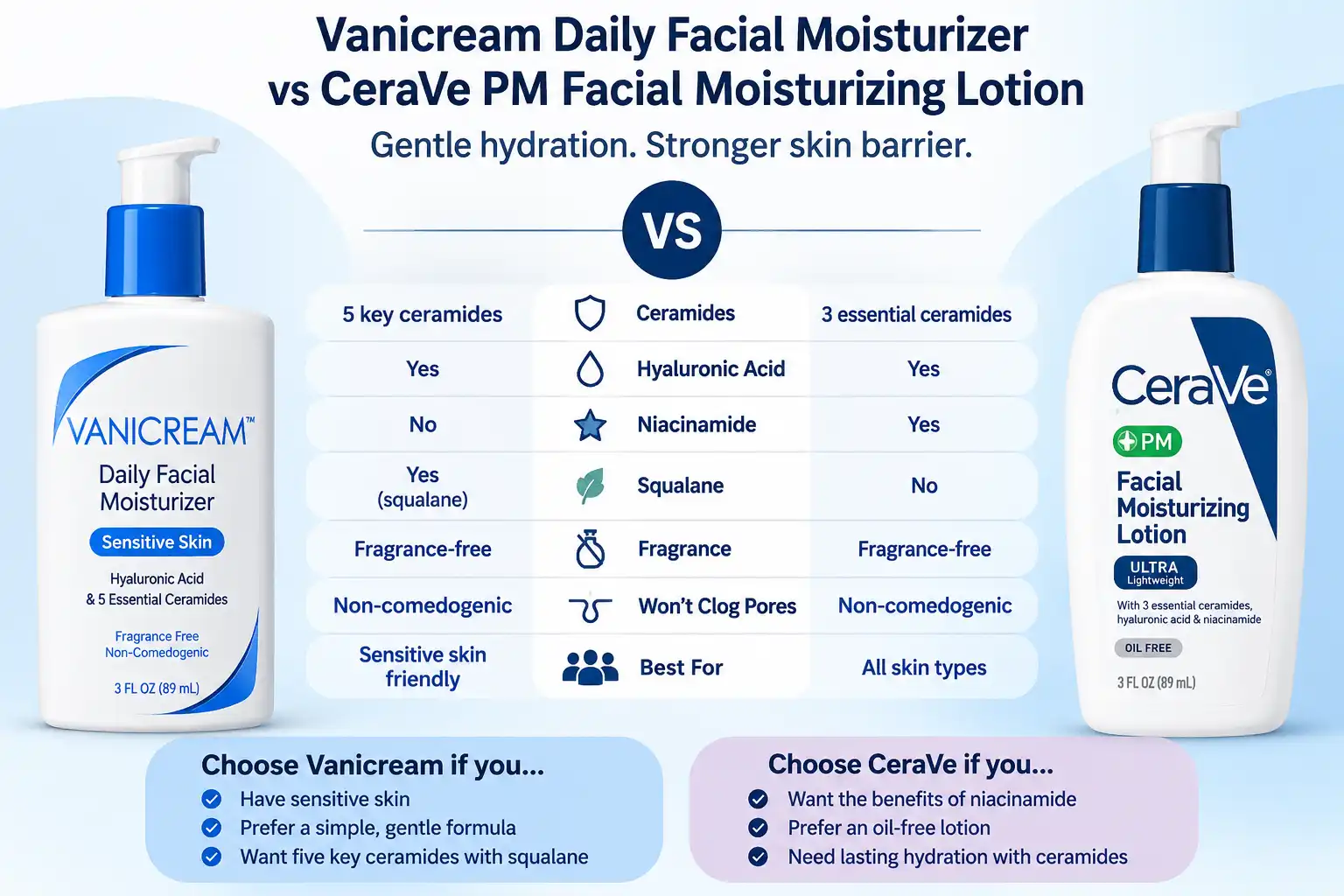
The two products people compare most often are Vanicream Daily Facial Moisturizer and CeraVe PM Facial Moisturizing Lotion. Both are lightweight, fragrance-free and non-comedogenic, and both use ceramides and hyaluronic acid to hydrate the skin and support its natural moisture barrier.
The differences are in the details. Vanicream uses five ceramides, squalane, and a short, sensitive-skin-first ingredient list. CeraVe PM uses three ceramides, adds niacinamide, and delivers everything through its time-release MVE technology.
So which one should you choose? Is Vanicream really better for sensitive skin? Does CeraVe hydrate better? And which one suits oily, dry, or acne-prone skin?
In this guide, I compare Vanicream Daily Facial Moisturizer vs CeraVe PM on ingredients, benefits, texture, and suitability for sensitive skin types. I’ve checked every ingredient claim against the brands’ own product pages, and I’ve added what years of using both have taught me. By the end, you’ll know which one belongs in your routine.
Key takeaways
- Vanicream Daily Facial Moisturizer and CeraVe PM Facial Moisturizing Lotion are both fragrance-free, non-comedogenic moisturizers made with ceramides and hyaluronic acid.
- It has five ceramides plus squalane. It contains no fragrance, dyes, botanical extracts, lanolin, or parabens, and it carries the National Eczema Association Seal of Acceptance.
- It has three ceramides plus niacinamide and cholesterol, released gradually through its MVE time-release technology.
- CeraVe PM contains it, and Vanicream doesn’t. That’s a plus if you want it, and one less thing to react to if you don’t.
- Wear sunscreen every morning, and see a dermatologist about persistent breakouts.
Vanicream Daily Facial Moisturizer vs CeraVe: Product Overview
Before getting into the differences, it helps to know what each moisturizer is built to do.
What Is Vanicream Daily Facial Moisturizer?
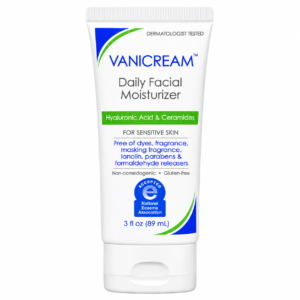
Vanicream Daily Facial Moisturizer is a lightweight face lotion from Vanicream, a brand that has been making products for sensitive skin since 1975. It’s designed to give your skin everyday hydration while supporting its natural protective barrier.
The formula pairs hyaluronic acid with five key ceramides to attract and hold on to moisture. Squalane, the second ingredient after water, softens the skin and helps reduce moisture loss.
What really sets Vanicream apart is what it leaves out. The formula is free of fragrance (including masking fragrance), dyes, botanical extracts, essential oils, lanolin, parabens, and formaldehyde. It also carries the National Eczema Association (NEA) Seal of Acceptance.
Vanicream describes the texture as a “rich, but lightweight lotion”, and that’s exactly how it feels. It absorbs quickly, doesn’t feel greasy, and sits comfortably under makeup. It’s also non-comedogenic, so it works for oily, combination, and acne-prone skin as well as dry skin.
Key features of Vanicream Daily Facial Moisturizer:
- Five key ceramides (EOP, NG, NP, AS, and AP) to support the skin barrier
- Hyaluronic acid and glycerin for hydration
- Squalane to soften the skin and reduce moisture loss
- Free of fragrance, dyes, botanical extracts, lanolin, and parabens
- Non-comedogenic and non-greasy
- Accepted by the National Eczema Association
- Suitable for morning and evening use
What Is CeraVe PM Facial Moisturizing Lotion?
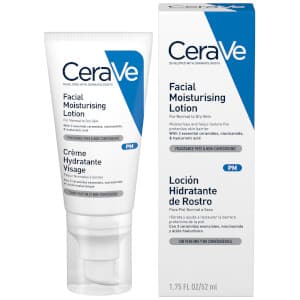
CeraVe PM Facial Moisturizing Lotion is a lightweight facial moisturizer developed with dermatologists to hydrate the skin and support its protective barrier.
As the name suggests, it’s positioned as a night moisturizer. CeraVe says you can use it in the morning too, but it has no SPF, so you’ll need to apply sunscreen over it during the day.
The formula combines three essential ceramides, hyaluronic acid, and niacinamide. Niacinamide sits fourth on the ingredient list, straight after water, glycerin, and caprylic/capric triglyceride. CeraVe doesn’t publish the percentage, but that position suggests it’s more than a token amount.
The standout feature is CeraVe’s patented MultiVesicular Emulsion (MVE) Delivery Technology. Instead of delivering everything at once, MVE releases moisturizing ingredients gradually, and CeraVe says the lotion hydrates for up to 48 hours.
It’s oil-free, fragrance-free and non-comedogenic, and CeraVe says its texture suits all skin types.
Key features of CeraVe PM Facial Moisturizing Lotion:
- Three essential ceramides (NP, AP, and EOP) to support the skin barrier
- Hyaluronic acid (listed as sodium hyaluronate) and glycerin for hydration
- Niacinamide to help soothe the skin and support barrier function
- MVE Delivery Technology for gradual, sustained hydration
- Oil-free, fragrance-free, and non-comedogenic
- Developed with dermatologists
- Made for evening use; works in the morning under sunscreen
A quick note on formulas: CeraVe PM isn’t identical everywhere. This guide is based on the North American formula. The version CeraVe sells in the UK has a different ingredient list, including several UV filters (although it carries no SPF claim), and it isn’t marketed as oil-free. Whichever country you buy in, check the ingredient list on your bottle.
Vanicream Daily Facial Moisturizer vs CeraVe: Key Differences
Both moisturizers contain ceramides and hyaluronic acid, but they’re built around different ideas. Vanicream focuses on gentle, minimal hydration for sensitive skin. CeraVe PM pairs hydration and barrier support with niacinamide and time-release delivery.
Here’s how they compare side by side:
| Feature | Vanicream Daily Facial Moisturizer | CeraVe PM Facial Moisturizing Lotion |
|---|---|---|
| Main purpose | Daily hydration and barrier support for sensitive skin | Hydration and barrier support, mainly overnight |
| Ceramides | Five (EOP, NG, NP, AS, AP) | Three (NP, AP, EOP) |
| Hyaluronic acid | Yes | Yes (as sodium hyaluronate) |
| Niacinamide | No | Yes |
| Squalane | Yes | No |
| Cholesterol | No (uses plant phytosterols) | Yes |
| Delivery technology | None claimed | MVE time-release |
| Added fragrance | No | No |
| Non-comedogenic | Yes | Yes |
| Oil-free | Listed as oil-free by Vanicream | Yes (North American formula) |
| Texture | Rich but lightweight lotion | Lightweight lotion |
| When to use | Morning and evening | Evening; mornings under sunscreen |
| Skin types | All skin types, designed for sensitive skin | All skin types |
The main takeaway: Vanicream suits people who want a simple, sensitive-skin-focused moisturizer with as little going on as possible. CeraVe PM suits people who want the extra benefits of niacinamide alongside ceramides and hyaluronic acid.
One thing worth knowing about the “oil-free” row: the term has no regulated definition. Both formulas still contain lightweight emollients (squalane in Vanicream, caprylic/capric triglyceride in CeraVe). That’s a good thing, because those lipids are part of what stops water escaping from your skin.
Vanicream vs CeraVe: Which Has Better Ingredients?
Ingredients are where most people start when choosing a moisturizer, and it’s where these two look most alike. They share several key ingredients, but combine them differently. Here’s how the most important ones compare.
1. Ceramides and Skin Barrier Support
Ceramides are lipids that occur naturally in your skin. Together with cholesterol and fatty acids, they form the “mortar” between your skin cells, keeping moisture in and irritants out.
When that barrier is damaged, your skin can feel dry, rough, tight, or more sensitive than usual. Moisturizers with ceramides help top up those lipids so the barrier can do its job.
Vanicream Daily Facial Moisturizer contains five ceramides:
- Ceramide EOP
- Ceramide NG
- Ceramide NP
- Ceramide AS
- Ceramide AP
It also contains phytosterols, plant-derived lipids that are structurally similar to cholesterol.
CeraVe PM Facial Moisturizing Lotion contains three ceramides:
- Ceramide NP
- Ceramide AP
- Ceramide EOP
CeraVe backs these up with cholesterol and phytosphingosine, a building block your skin uses to make ceramides.
Which is better? Five is more than three, but ceramide count isn’t a scorecard. Neither brand publishes concentrations, and how the whole formula works together matters more than the number on the box. I’ve leaned on both to recover from a damaged barrier over the years, and I can’t honestly say one worked noticeably faster than the other.
2. Hyaluronic Acid for Skin Hydration
Hyaluronic acid is a humectant. It draws water into the outer layers of your skin and helps hold it there. It’s particularly helpful if your skin feels dehydrated or tight after cleansing.
Vanicream lists hyaluronic acid alongside glycerin, its third ingredient and another reliable humectant.
CeraVe PM lists it as sodium hyaluronate, the salt form of hyaluronic acid used in most skincare. Glycerin is its second ingredient.
Which is better? Both contain hyaluronic acid and glycerin, so it’s a draw. Having hyaluronic acid on the label doesn’t make one moisturizer more hydrating than the other. The full formula and how your skin responds matter more.
A tip that works with either product: apply it to slightly damp skin, within a minute of patting your face dry. Humectants have more water to work with, and your skin feels noticeably plumper.
3. Niacinamide in CeraVe
Niacinamide is the biggest ingredient difference between these two moisturizers. Also known as vitamin B3, niacinamide is popular because it does several useful things at once. Its potential benefits include:
- Helping support the skin’s protective barrier
- Helping the skin hold on to moisture
- Calming the look of redness
- Improving the appearance of uneven skin tone
- Smoothing the look of skin texture
CeraVe PM contains niacinamide. Vanicream Daily Facial Moisturizer doesn’t.
Most people tolerate niacinamide well. A small number, though, feel temporary tingling or flushing, especially when they’re already layering it from another product. If you use a niacinamide serum, doubling up in your moisturizer rarely adds much.
Which is better? If you want a moisturizer that combines hydration with niacinamide, CeraVe PM has the edge. If you already use a niacinamide serum, or you’d rather keep actives out of your moisturizer, Vanicream is the cleaner choice. And remember, niacinamide isn’t essential. Plenty of healthy routines work perfectly well without it.
4. Squalane in Vanicream
Squalane is the other ingredient that sets Vanicream apart. It’s a stable, lightweight emollient, closely related to squalene, a lipid your own skin produces. It softens the skin and helps reduce moisture loss.
In Vanicream, squalane is the second ingredient after water, so it’s doing a lot of the work. It’s a big part of why this lotion feels more cushioning than you’d expect from something so light. That makes it especially useful if you’re dry but don’t want a heavy cream.
CeraVe PM doesn’t contain squalane. Instead, it relies on other moisturising and barrier-supporting ingredients, including caprylic/capric triglyceride, cetearyl alcohol (a non-drying fatty alcohol), dimethicone and cholesterol. Dimethicone, in particular, gives CeraVe its smooth, silky finish.
Both formulas leave you well-moisturized. They just take different routes to get there.
Texture and Feel: How They Wear Day to Day
Both brands call their product a lightweight lotion. On the skin, though, they feel a little different, and texture is often what decides whether you’ll actually keep using a moisturiser.
Vanicream Daily Facial Moisturizer spreads easily and sinks in within a minute or so. It leaves the skin soft and comfortable rather than slick. Thanks to the squalane, there’s a slight cushioned feel that I find soothing on dry or irritated days. It never feels heavy, even on warmer days.
CeraVe PM feels a touch thinner and more fluid. It spreads quickly and dries down to a smooth, almost velvety finish, helped along by dimethicone. On oily or combination skin, it can feel close to weightless.
Under sunscreen and makeup, both work well. One habit I’d recommend with CeraVe PM: give it a minute to settle before you apply sunscreen. If I rush and layer certain silicone-heavy sunscreens on top straight away, it occasionally pills. Vanicream has rarely given me that problem.
How much to use: a small amount goes a long way with both. Start with a little less than you think you need for your face and neck, and add more only if your skin still feels tight.
Vanicream vs CeraVe for Different Skin Types
The best moisturizer isn’t the one with the longest ingredient list. It’s the one that gives your skin the hydration it needs without irritation or discomfort. Here’s how Vanicream and CeraVe compare for each skin type.
Which Is Better for Sensitive Skin?
If your skin is sensitive, a gentle formula matters more than anything else.
Vanicream Daily Facial Moisturizer is made for exactly this. It leaves out fragrance, masking fragrance, dyes, botanical extracts, lanolin, and parabens, all ingredients that sensitive skin often reacts to. Its NEA Seal of Acceptance is a useful extra signal if your skin is eczema-prone. Ceramides, hyaluronic acid, and squalane then hydrate and support the barrier.
CeraVe PM is also fragrance-free, and CeraVe describes it as suitable for sensitive skin. It contains ceramides, hyaluronic acid, and niacinamide. Most people tolerate niacinamide well, but if your skin is very reactive, it’s one more active ingredient that could disagree with you.
My recommendation: Vanicream is the stronger pick for sensitive skin, especially if your skin reacts to almost everything. CeraVe PM is still worth considering if you know your skin tolerates niacinamide. If you have eczema or another skin condition, ask your dermatologist which moisturizer suits your treatment plan.
Vanicream Daily Facial Moisturizer vs CeraVe: Which Is Better?
After comparing their formulas, ingredients, textures, and suitability for different skin types, one thing is clear: both are genuinely good moisturizers. The better choice depends on what you want your moisturizer to do.
Choose Vanicream Daily Facial Moisturizer if:
- You have sensitive or easily irritated skin and want a formula designed around it
- You want five ceramides plus squalane for a soft, cushioned finish
- You’d rather avoid niacinamide, botanical extracts, and other extras
- You want one moisturiser you can use both morning and evening
- An NEA Seal of Acceptance matters to you
Choose CeraVe PM Facial Moisturizing Lotion if:
- You want ceramides, hyaluronic acid and niacinamide in one step
- You prefer a very light, oil-free texture with a smooth finish
- You like the idea of MVE time-release hydration overnight
- You don’t already use a separate niacinamide serum
- Your skin is oily, combination or acne-prone and tolerates niacinamide well
Final Thoughts: Should You Choose Vanicream or CeraVe?
When it comes to Vanicream Daily Facial Moisturizer vs CeraVe PM, you’re choosing between two very good ways to hydrate your skin and support its barrier.
Vanicream is the one to pick if you want a sensitive-skin-first moisturizer with five ceramides, hyaluronic acid, and squalane, and nothing you don’t need.
CeraVe PM is just as worth considering if you want a lightweight lotion that pairs ceramides and hyaluronic acid with niacinamide.
After more than a decade with both, my honest advice is this: pick the one that matches your skin’s biggest need, use it consistently for a few weeks, and let your skin give you the final answer.
Whichever you choose, the basics still do most of the heavy lifting: gentle cleansing, consistent moisturizing, and sunscreen every single day.
References
- Vanicream Daily Facial Moisturizer — Vanicream (ingredients, free-from list, NEA seal, directions)
- PM Facial Moisturizing Lotion — CeraVe Canada (North American formula, ingredients, claims, directions)
- PM Facial Moisturizing Lotion — CeraVe UK (UK formula comparison)
- Vanicream Sensitive Skin Care Launches Enhanced Moisturizer — PR Newswire, March 2026 (brand history since 1975
